
Bloodsport
on 80s movies, American identity, and that fight on the White House South Lawn

When the movie Bloodsport came out in 1988 I was 16 years old. I was a small, skinny kid, barely a hundred pounds, and I’d been taking martial arts lessons for 4 years.
I had been watching martial arts movies for longer than that. On weekends my best friend and I rented Game of Death with Bruce Lee and The Octagon with Chuck Norris. In the action-adventure section of our small town video store we found The Five Deadly Venoms and Master of the Flying Guillotine. Billy Jack and Good Guys Wear Black.
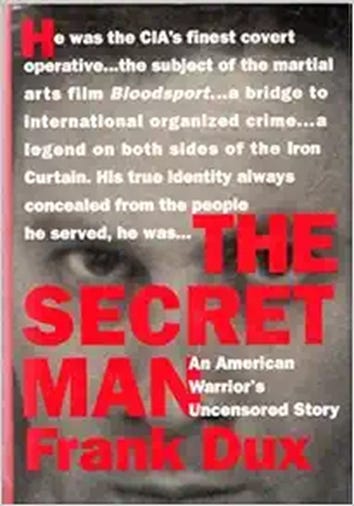
Bloodsport, if you’ve never heard of it, was Belgian 80s martial arts actor Jean Claude Van Damme’s breakout role, and it was based on the true story, the movie’s outro text told us, of a man named Frank Dux.
In the movie, Dux, portrayed by Van Damme, is an Army captain who defies direct military orders and flies to Hong Kong to compete in a secret martial arts tournament (known as a kumite). As a foreigner, Dux has little chance of winning, but his American tenacity, along with his intense ninja training, prevail.
To fill in Dux’s story, the movie flashes back to his ninja training. In one scene Dux learns to catch fish swimming in a tank. In another he demonstrates the “dim mak,” an ancient, secret, killing technique. In still another scene Dux trains while blindfolded, which is fortuitous, since he is blinded in the final fight of the tournament and must rely on his training.
Today, Dux’s wesbite describes him as a knight in the order of St. Michael, a “hunter” who possesses the “unique ability to investigate extremely dangerous and complicated matters,” and “covert operator whose work is of such a highly sensitive nature that it would require court proceedings to even acknowledge their existence.”
But as a skinny teen I never cared about Dux’s real life. My best friend didn’t either. Every time we watched Bloodsport we ended up in the front yard afterward, fighting one another, training hard. There were bullies to contend with at school, and—I now surmise, close to 40 years after the fact—we were already afraid we might, someday, be called to fight in a super-secret martial arts tournament to bring glory to ourselves, and our country.
In retrospect, we should have been more afraid of the bullies.
But if it seems a little far-fetched to believe we might someday be asked to fight for our country, let me remind you of the atmosphere of the 1980s, and how that atmosphere manifested itself in our movies. In 1983 The Outsiders were fighting on the streets of Tulsa, Oklahoma. Wargames was showing what might happen if the computers ever took control, and the next year The Terminator would reinforce that message. Gene Hackman was traveling back to Vietnam to look for his MIA son in Uncommon Valor. Krull told us we might have to fight aliens, too, and Return of the Jedi set up the expectation that even emperors might occasionally need to be tossed down an air chute in the Death Star if they got up to too much evil shit.
There were also a lot of movies that specifically showed Americans fighting against other forces. Americans winning against other forces. Americans annihilating anyone challenging them, including aliens and terminators and foreigners from other countries.
In Best of the Best, American fighters squared off against South Korean fighters. Gymkata starred Olympic gymnast Kurt Thomas as Jonathan Cabot, an Olympic gymnast who combines his gymnastic ability with martial arts to enter a deadly competition in a fictional country. He must also save a princess or something.
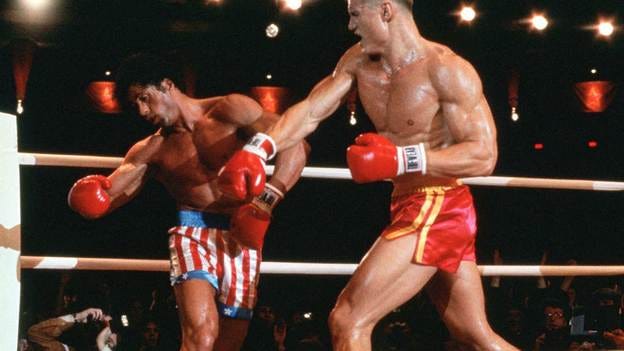
Then there was Karate Kid. Rocky IV. Invasion USA, in which Chuck Norris must stop terrorists hellbent on destroying America. Karate Kid taught a generation of Americans that the martial arts would help them kick the shit out of bullies, like those old advertisements in the back of comic books. Rocky IV, released at the height of the Cold War, showed us any ordinary American could outfight a trained Soviet, for what was Rocky but an ordinary American with an oversized American heart?
In my second book I wrote an essay about Red Dawn, and the idea that Americans could rise up like rebels to overthrow any invading enemy, our hunting rifles suddenly able to take out Soviet tanks. Our fierce high school football teams transforming themselves into the finest fighters the world has ever seen, able to push any foreigners into the ocean, or oblivion. (Here’s a direct link to the Red Dawn essay, published at The Rumpus, if you are so interested.)
See somehow we have been led to believe we have to fight to survive, like that old Survivor song. For most of Gen X, our lives have been surviving one catastrophe after another. One war after another, one economic shock after another. The news tells us every day the world is declining, and the only way we can survive is to build big high walls around us with military machines. With bullets and bombs, with air defense systems, with drones and missiles and men on the ground, because someday, if we don’t do it first, they will come for us.
Our movies told us so.
Our American love of movies started with war, and Westerns.
In 1897 French filmmaker Georges Méliès released a series of short silent films depicting events related to the Greco-Turkish War. Méliès also made short science fiction films, but during World War I over 400 of his films were melted down by the French to make heels for shoes, which sounds like a really French thing to do.
The first feature-length war movie was Birth of a Nation, D.W. Griffith’s epic and racist portrayal of the American Civil War. It was the first American-made film to have a musical score for an orchestra, was a technically advanced film for the time, and it includes a carefully staged battle sequence with hundreds of extras made to look like thousands.
The first war film to win Outstanding Picture was Wings, a World War I film about two men who become fighter pilots. It was the role that launched Gary Cooper’s acting career.
Westerns appeared with the advent of film as well. In 1894 Thomas Edison filmed short, single-reel scenes featuring stars like Annie Oakley and veterans of Buffalo Bill’s Wild West Show. In 1899 the one-minute British silent short Kidnapping by Indians (filmed by Mitchell and Kenyon in Blackburn, England) is considered the earliest known narrative film of the genre.
In 1903 Edwin S. Porter’s The Great Train Robbery, an 11 minute film, created the themes of crime and pursuit and retribution that defined the Western genre. In 1906 the Australian silent film The Story of the Kelly Gang became the first multi-reel feature-length film, and it helped popularize bushranger (outlaw) Westerns.
According to documentarian David Gregory, “it has been estimated that up to 40 percent of all films made before 1960 were Westerns.”
What emerged from this saturation of the market was a mythos that was quintessentially American. The films harkened to a period in our nation’s history when the notion of national identity was an unformed mass before the crucible of the Civil War melded America into one undivided country.
Not as many Westerns were made in the 70s and 80s. The culture shifted. People changed. We had other things to worry about, like foreigners, and terrorism, but I maintain that the American martial arts and action movies from the 80s were simply a re-envisioning of Westerns from the 50s and 60s, while borrowing and repurposing themes from Chinese martials arts films from the 70s. Westerns and war movies are all the old men of my time watched, so much so they believe that vision of John Wayne on the range. John Wayne at the Battle of Iwo Jima. John Wayne clearing out the American West, the quintessential American cowboy.
Then, in the conservative culture of the 80s, Reagan became the quintessential American cowboy. He played a cowboy. He dressed up like a cowboy. He spoke like a cowboy and invaded other countries like a cowboy, and somewhere in the 80s America began to believe its own created cowboy mythos. See also: Yellowstone.
No one could defeat Rocky, not even a super-engineered Soviet twice his size. The American Frank Dux not only won the super secret kumite, but he broke all the records. Chuck Norris saved America from terrorists. The Wolverines hid among the Colorado rocks to carry on their guerilla war to liberate the country.
They all won. They always win, because we are always the cowboys. Always the platoon storming the beach. We are the liberators. The winners. The biggest and baddest and strongest, doing the most good in the world.
Our movies tell us so.
The Ultimate Fighting Championship was originally envisioned as a way to pit fighting styles against one another. It was supposed to be a true test of martial arts prowess, like Olympic wrestling.
But immediately us money-grubbing Americans began billing it as bloodthirsty and violent. In the first few championships the only rules were no eye-gouging and no fishhooking and no kicking a man in the face while he is unconscious. I remember watching it as a young skinny kid who desperately wanted to be able to defend himself. Who already saw how the bullies on the bus would multiply. Who foresaw angry men rising into power, the billionaires who can never eat enough to be full and so keep taking and taking and taking. Who foresaw war and war and war, bigger and badder militaries, until the whole world is covered in bombs.
Fast forward 30 years and we have UFC, which has become as Americanized as a strip mall. It has become a trash-talking-martials-arts-out-the-window spectacle in which fighters have become their own commodity, with all the ego inherent, and all the glory of gladiators.
That thing a few weeks ago on the White House South Lawn was to show power. To flex and project before the world our military might. It was to embrace the idea of masculinity, the warrior ethos Hegseth keeps pooping out his mouth, despite the fact that he’s never been in a fistfight. It’s no different than vain men have been doing since the first preening asshole rose up out of the rocks. It’s no different than boys in men’s skin flexing in the locker rooms of America, where all the pussy-grabbing talk goes on.
Now you can find hours and hours and hours of UFC knockout videos on YouTube. Backyard brawling videos, streetfighting videos, cagefighting and wrestling and people breaking boards. You can find videos of drone attacks. Tanks firing and their targets exploding, Tomahawk missiles launching from the decks of battleships, Baghdad shaking and smoking under the weight of American shock and awe.
As if we always need to defend ourselves.
As if we are always fighting.
As if a war is always going on, one we started.
Bloodsport was marketed as a true story, but—surprise, surprise—it was actually based on heavily fabricated claims.
That is to say Frank Dux lied. He lied, he lied, he chicken-fried.
Dux was born in Toronto, Canada in 1956, but moved to California with his family when he was seven. In California, Dux claims, he came under the tutelage of master Senzo “Tiger” Tanaka, who brought him to Japan for ninja training.
“When the boy reached 16 years of age, Tanaka brought him to Japan, to the legendary Ninja land of Masuda,” Frank Dux wrote in his memoir. “There, the boy’s outstanding abilities shocked and pleased the Ninja community when he tested for the right to call himself Ninja.”
Not sure why he’s writing about himself in the third person, but maybe Dux knows more about writing than I do.
Anyway, in 1975, Dux enlisted in the Marine Corps. That happened.
But while in the Corps, Dux says he was secretly invited to a 60-round Kumite championship in Nassau. By his account he was the first Westerner to win the ruthless tournament, setting world records for most consecutive knockouts (56), the fastest knockout (3.2 seconds), and the fastest punch (0.12 seconds).
But investigators have debunked almost all of his stories. Investigations into his military history showed he never left the United States (primarily stationed in San Diego) during his enlistment, making his secret global missions impossible. The supposed secret, underground tournament has never been proven to exist outside of Dux’s own accounts. Dux also presented acquaintances and witnesses to verify his stories, but many of them later confessed to lying or were revealed to be his high school friends who were paid or instructed on what to say. Finally, Bloodsport Screenwriter Sheldon Lettich eventually admitted that the “true story” was just a collection of tall tales he heard directly from Dux.
Dux spends a lot of energy on his website repeating his claims. Almost as if he in invested in this identity of a fighter, secret agent, undercover operative.
I wonder if he believed his own hype. If he got caught up in the character.
I wonder if America has got caught up in some character. If we are play-acting now, trying to prove to everyone we are the biggest and the best. The strongest and swiftest. The meanest and maddest.
But I think everyone else in the world sees the mythos of America. They understand, in a way that we perhaps do not, that we are not our movies. We are not our martial arts. We are not the heroes of our Westerns or wars, nor should we be finding value in such things as wars and expanding westward.
We are just telling the story the way we want it told.
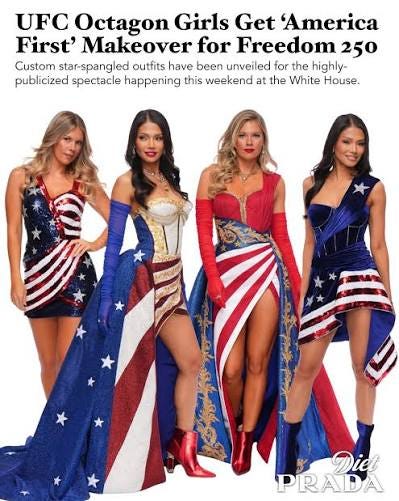
I’m going back to that cagefight on the South Lawn again because it’s the same old ugly thing. It’s men showing other men how tough they are, and while maybe we could argue about the legitimacy of martial arts and challenging ourselves with competition, when you promote it with Redbull and drap the ring girls in the American flag, we’ve left honor behind.
What I find so awkward about the men of this country is that we believe in this idea of protecting America and women and our children with our fists and with guns, and yet we pass laws that harm them over and over. We do things that harm them, like fights on the White House Lawn. We see ourselves as fighters, cowboys, renegades who protect all we love, but really we are just telling ourselves a lie. We are making up stories with no basis in fact. Like movies. Like something designed to make us feel better, not rooted in reality. Westerns were fake, friends. They were untrue. Mostly the West was a massacre of indigenous peoples, America built on the blood and bones of those we’ve diseased or destroyed. It was a massacre of animals like the bison. A massacre of foreigners like the Chinese who built Western railroads.
And then there’s the cheap and tawdry spectacle of it all. The advertisements appearing in the air above the White House. The rockets red glare, the motorcycles flipping gears, the ring-girls wearing American flags.
It was ugly, y’all. So, so ugly and unnecessary and unfortunate for all of us that this is the moment we have to deal with. We could have everything in the world, friends. We could have healthcare. We could have world peace. We could feed every child on this planet and educate every human, but all throughout history there have been small men who want to fight on the front lawn like 16 year olds. Like children who have never learned how to get along. Like humans dead-set on destroying themselves, writing a movie in which we are, ultimately, the losers.
Alexander wept when he saw there were no more worlds to conquer.
What will we do, America? Turn our greedy eyes to space?

https://allthatsinteresting.com/frank-dux
https://www.hollywoodreporter.com/movies/movie-news/shadow-superheroes-westerns-are-quietly-popular-971841/
I also grew up in the era of these movies Paul, and even as a girl I remember them being idolized (even I idolized them). I was in martial arts for years, even taught it for years, and interestingly what I discovered was that the deeper I got into the “art” of it, the less the fighting seemed appealing and the more the discipline of mindful control felt appealing.
What I love about your posts is that you take the masculinity and cultural norms of the past; and consistently show how we can move past them into something more beautiful, more loving, more peaceful and honest.
I’m not an American, but I think the growing you so often allude to is universally relatable, and I wish every man would read your words. Makes me hopeful for my own son ❤️
My great uncle had a small role in Red Dawn. “Boys! Avenge me! Avenge me!” We didn’t see great Uncle Harry very often- he avoided family gatherings for reasons I now understand as an adult. He took the role because as he told my uncle- “I just needed the work, I wasn’t all political about it. “ He’d been in a lot of cowboy roles before in Hollywood. He’d done his share of some messed up male roles. Some of my great uncle’s roles I truly loved and enjoyed had complexity, depth- even as a villain (Big Love) or as Travis Henderson in Paris, Texas.
The 80’s were full of action movies I didn’t particularly like- and I’m a gal who loves well choreographed battles, fights, martial arts, sword play and realistic depictions of gun use. It was very mythic action scenarios, lone wolf saves the day, or we are Americans and therefore always the good guys kind of propaganda. It was hyper masculine and kind of silly when you view it thru reality or with real soldiers or police who have gone thru war or scary situations who laugh at what is put forth on the screen. But I get why so many guys latched on to them- it’s a kind of American mythology/legends.
We are a nation founded by violence, the gun to us is like the spear and shield was to the Greeks speaking of legendary warriors and myths. We idolize and fetishize “taking action” when often, cooler warrior heads with experience will emphasize the ability to either walk away, negotiate, or to find a way that causes the least harm to yourself and others. It also feeds into the sad, horrible idea that men are flat characters- hungry, horny, or angry and maybe they will fight for justice, revenge, or a sense of innate superiority based on their country or religion. The 80’s action movies kind of flattened men- just as they flattened portrayals of female characters into tropes and stereotypes. The best action films, in my opinion, show how messy that approach really is- Saving Private Ryan, the beginning scenes, especially. The action is shored up by the drama underneath. Do I love a Guy Ritchie film? I do love some of those characters and the dark humor. Some Bond films are fun to watch- the gadgets, the chase scenes in later Craig movies.I love the John Wick films even though the gun play is just out there nuts. They are more comic book like to me, not to be taken as real world info on gun battles, spying, or how to handle gangs and thugs and criminal activities in the UK. But if you’re basing your coping skills as a human on action films- you’ll wind up in jail, dead, or severely injured.
But American exceptionalism kind of props up this silly idea of the car chase, the gun battle, the lone warrior kicking multiple enemies asses. And here we are now- a nation losing global allies right and left, a Sec of Def wanting soldiers to take additional testosterone and lying about our injured in war but not really a war because an orange thin skinned narcissist says so. No one should base their global military strategy on 80’s American action films.
I enjoyed this- because you are being honest about what it felt like as a young man at that time, viewing these films. It’s like all the cringe I feel when teen me loved some of John Hughes more problematic films and now as a middle aged adult going,” Oh wow, I actually thought that was funny or romantic or whatever.” At the time, I thought Breakfast Club was revolutionary and Sixteen Candles was hilarious. There are some bits that are still funny- but many others are just kind of icky, racist and creepy towards women.
Also- ever watch Chuck Norris in Walker, Texas Ranger? That show was completely unhinged.